Hungry Balls
- 4.6
- Rating
- 5.00M
- Installs
- Free
- Price

 Analysis by App-foxy
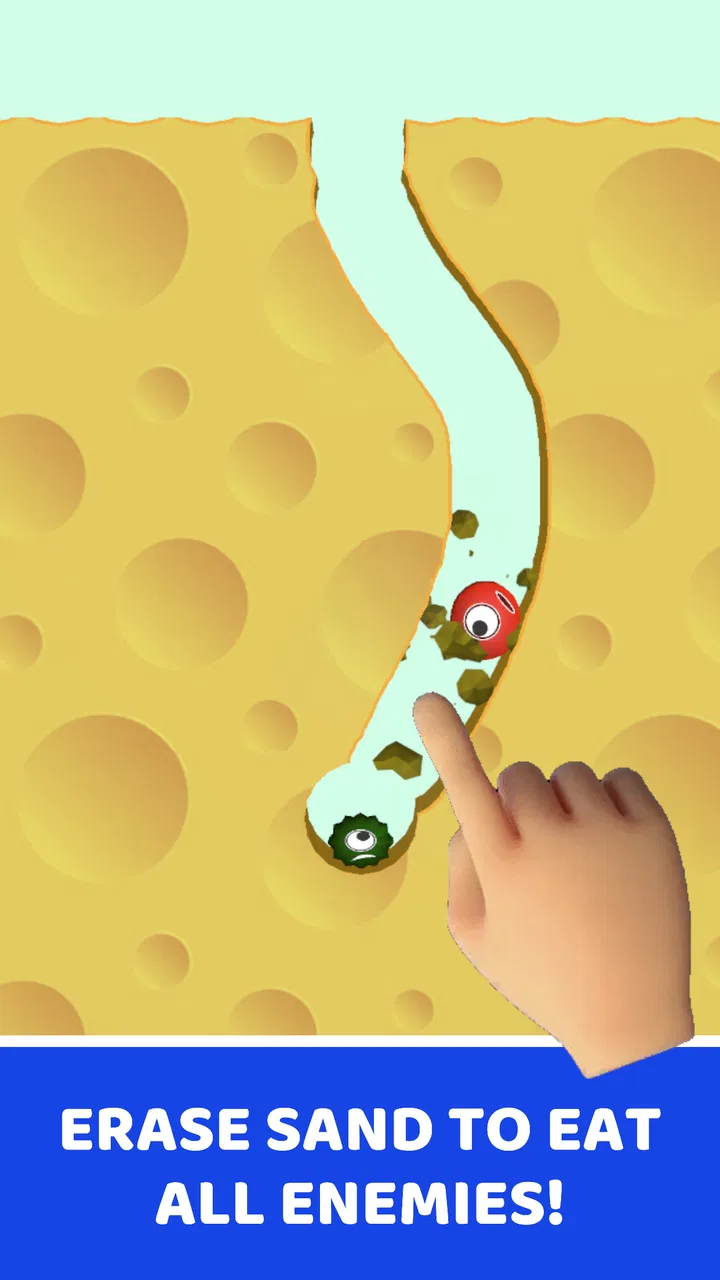
I like puzzle games that explain themselves quickly but still make me pause before every move. Hungry Balls fits that space with a simple idea: I erase sand so small balls can fall, roll, and reach what they are meant to eat. The presentation is easy to understand, yet the physics turn each level into a short exercise in timing, prediction, and controlled experimentation.
It is a free puzzle game from HYPERCELL, aimed at Teen players and available for devices running Android 7.0 or later. The game has reached over a million installs and holds a 4.6 average from around nine thousand ratings, which suggests that its quick, tactile format has found a sizeable audience. I can see why: a single attempt takes little commitment, but the result often feels satisfying when the path works exactly as planned.
How the basic puzzle loop feels in everyday play
The normal workflow is refreshingly direct. I look at the arrangement, identify where the sand is supporting or blocking the hungry balls, then swipe through the areas I want to remove. Once the sand disappears, gravity and momentum take over. The important decision is not simply where to dig first, but how the remaining sand will redirect the movement afterward.
You May Also Like

 Blood Strike: 2.5 Anniversary
Blood Strike’s Loadouts Turn Every Drop Into a Tactical Gamble
A close look at Blood Strike’s custom loadouts: how fast access to signature weapons reshapes its battle royale rhythm, rewards preparation, and narrows the gap between fights.

 Pandora - Music & Podcasts
Pandora’s Music Is Easy to Start, but Harder to Recover
Pandora’s strength is its low-effort path from a seed to a station. Its weak spot is how much confidence it asks you to place in connection, setup, and quiet recovery.

 8 Ball Pool
 Is Built on Rivalries, Rematches, and Routine
A close look at the rivalries, rematches, shared routines, and unanswered safety questions that turn a quick pool match into a persistent mobile community.

 Samsung Music
’s Quiet Strength Is Playing What You Already Own
Its reach comes less from spectacle than from dependable access to a personal library. That simplicity is both the app’s strongest retention engine and its ceiling.

 AccuWeather: Weather Radar
AccuWeather Review: A Quick, Clear Forecast for Everyday Decisions
For everyday plans, the best forecast is the one you can understand quickly. AccuWeather makes rain timing, radar, and local conditions easy to act on, with a few trade-offs.

 Hill Climb Racing
Why Hill Climb Racing Still Turns Crashes Into One More Run
A tiny car, a bumpy hill and one more upgrade: Hill Climb Racing keeps resurfacing because its simple chaos makes every near-miss feel personal.
More From Our News Desk



That distinction gives the game more thought than its short store summary might suggest. A careless swipe can open a route too early, send a ball in the wrong direction, or remove the support that would have created a useful slope. When that happens, I usually restart mentally before restarting on screen: I ask which part of the route failed and whether I can change the order rather than merely erase more sand.
The best way to approach a new puzzle is to spend a moment observing before touching the screen. I check the position of every ball, the target areas, and any narrow passage that could act as a funnel. I also look for sections where sand is doing two jobs at once, such as holding a ball in place while shaping the path for another. Those shared structures are where a fast swipe is most likely to create trouble.
For a short session during a commute or while waiting for an appointment, that loop works well. I can play one level, think about a failed route, and put the phone away without losing the appeal of the game. It does not demand the long concentration of a traditional logic title, but it still gives me a reason to replay a puzzle when my first solution was messy.
The game is also approachable for people who do not normally play puzzle games. There is no complicated control scheme to learn, and the physical result is visible immediately. A child or casual player can understand the objective quickly, while a more experienced player can focus on using fewer, cleaner movements and anticipating how the sand will collapse.
That accessibility comes with a trade-off. If you prefer puzzles with written clues, elaborate deduction rules, or a large strategic system, this may feel lightweight. The challenge comes mainly from spatial layout and physics, not from building an inventory, managing resources, or solving a story mystery. I would choose a conventional logic game instead when I want a deeper chain of abstract reasoning rather than a tactile experiment.
Small habits that make the first attempt more useful
My most reliable habit is to treat the first try as a reading pass, not a race. I watch what the balls do after the first opening and note which surfaces slow them down or redirect them. Even when the attempt fails, that movement reveals whether the puzzle rewards a broad opening, a narrow channel, or a staged release.
I also avoid starting at the most obvious empty-looking area. A large patch of sand may seem like the natural place to swipe, but it can be supporting a useful angle elsewhere. Instead, I begin with the smallest removal that tests my theory. This preserves more of the original structure and makes it easier to understand the cause of a mistake.
Another practical technique is to separate movement problems from timing problems. If a ball never reaches the correct side, the route is wrong and I need to change the shape of the channel. If it reaches the right area but collides or stops short, the order of removal may be the real issue. Making that distinction prevents random repeated swipes.
When several balls are involved, I try to identify which one has the fewest safe options. That ball becomes my priority. A ball with plenty of open space can usually wait, while one trapped behind a fragile sand wall may determine the entire solution. This simple ranking is more useful than attempting to make every ball move at once.
Settings and practical checks before settling into a session
Because this is a gesture-driven game, I first check that my screen responds comfortably to swipes and that I am not holding the phone in a way that hides the play area. On a smaller display, my finger can cover the exact section I am trying to judge, so I prefer short movements followed by a pause to inspect the result.
I also pay attention to the game’s current build. The installed version is 1.7.0, and keeping the app current is sensible for anyone who wants the same behavior described in the latest store experience. I would not assume that a puzzle will behave identically after every update, especially in a physics game where small changes can affect how movement feels.
The age classification is Teen, so I would not automatically hand it to a very young child without checking whether the content and interaction style suit them. The rating is part of the practical decision, even though the core action looks playful and uncomplicated. For a family device, I would review the store page and device controls before making it a regular game for children.
There is another setting-related consideration that is easy to overlook: comfort. Repeated swiping can become tiring if I use broad, forceful gestures. I get better control with lighter, deliberate strokes, particularly when a narrow cut is needed. That is not a hidden option or a special mode; it is simply a better way to work with the game’s central input.
I would also decide in advance whether I want a relaxed puzzle session or a completion-focused one. The first approach values discovery and accepts restarts. The second makes me more cautious, because I am trying to find a clean route rather than merely reach the target. Switching between those mindsets helps me avoid blaming the game when I am actually imposing a stricter goal on myself.
Faster patterns for experienced players
Once the basic workflow becomes familiar, I start looking for repeatable patterns. The first is the controlled funnel: I remove enough sand to create a channel, but leave the sides intact so the balls cannot spread into unhelpful directions. This is usually safer than clearing a wide area and hoping gravity sorts everything out.
The second is staged release. If one ball is positioned above another, I do not necessarily want both moving immediately. I look for a way to let the lower or more vulnerable ball pass first, then open the route for the next one. This reduces collisions and gives each movement a clearer purpose.
A third pattern is using a small remaining ridge as a guide. It is tempting to erase every barrier, but a thin strip of sand can act like a wall and keep a ball aligned. Experienced play is often about preserving the right obstruction rather than removing everything in sight. The fastest solution is frequently the one that changes less.
I find it helpful to plan in terms of consequences rather than individual swipes. Before cutting, I ask where the loose sand will go, which ball will move first, and whether the opening can still be adjusted afterward. This turns each gesture into part of a sequence instead of a reaction to whatever happens on screen.
When a route almost works, I make one change at a time. If I alter three sections of sand together, I cannot tell which adjustment helped. A single-variable retry takes longer in the moment but teaches me more, and that knowledge carries over to layouts with similar slopes or bottlenecks.
There is also a useful distinction between visual symmetry and physical symmetry. Two sides of a puzzle may look balanced, but the balls can have different starting positions or different amounts of space to build momentum. I do not assume that a mirrored swipe will produce a mirrored result. I follow the actual route of each ball instead of trusting the picture to be perfectly even.
For players chasing consistency, I recommend finishing a level once with a safe solution before experimenting with speed. A fast attempt made without understanding the layout is mostly luck. After I know which sand pieces are essential, I can shorten the sequence and make the result more repeatable.
Where the physics help, and where they create friction
The physics are the game’s main personality. They make a successful solution feel earned because the balls do not simply teleport along a marked path. They roll, fall, and react to the shape I create. That physical response also keeps failure understandable: I can usually see the exact moment when a ball loses its route.
At the same time, physics can make a result feel less predictable than a purely rule-based puzzle. A tiny change in the cut may produce a noticeably different movement, and a solution that looks correct can still fail because the opening was made in the wrong order. Players who prefer exact, deterministic logic may find this less satisfying than a grid-based puzzle where every move has a fixed outcome.
My advice is to accept experimentation as part of the design rather than treating every restart as wasted time. The game is at its best when I use a failed attempt to learn the level’s behavior. It is less enjoyable when I expect the first swipe to reveal a perfect answer with no adjustment.
Touch accuracy matters as well. On a phone with a cramped display, it can be difficult to make a narrow cut without covering the target area. I solve that by starting slightly away from the most important point and using smaller gestures. If your hands are uncomfortable with repeated swiping or your screen is very small, the tactile format may become more frustrating than relaxing.
The Teen content rating is another reason I would consider the intended audience before installing it for a shared family device. The game’s puzzle structure is easy to grasp, but suitability is not determined by controls alone. I would use the rating as a prompt to make a personal decision rather than assuming that a cartoon-like physics game is automatically appropriate for everyone.
How it compares with familiar puzzle alternatives
Compared with a match-three game, this offers less emphasis on collecting combinations and more on planning a physical route. There is no need to scan a board for the next color pattern; I am shaping the environment itself. That makes it a better choice when I want a compact spatial challenge and a weaker choice when I want a constant stream of quick rewards.
Compared with a traditional Sudoku or nonogram, the reasoning here is less numerical and more visual. I am not proving a solution through a fixed set of clues. I am predicting motion and adjusting terrain. Someone who enjoys quiet, methodical deduction may prefer those alternatives, while someone who likes seeing an idea immediately play out may find this more engaging.
It also differs from physics sandbox games because the objective is focused rather than open-ended. I am not simply dropping objects to watch what happens; I am working toward a specific feeding route. That focus makes individual sessions easier to manage, although it may feel restrictive to players who want tools for building their own experiments.
For me, the strongest comparison is with other one-touch puzzle games. Hungry Balls has the advantage of making the gesture meaningful: the swipe changes the terrain, and the terrain determines the movement. Its limitation is that the same interaction can become repetitive if I play for too long without a change in challenge or presentation. I prefer it in short bursts rather than as my only puzzle game.
Who should install it, and who should skip it?
I would recommend it to casual players who enjoy visual cause and effect, people looking for short phone sessions, and puzzle fans who like experimenting with gravity and space. It is especially suitable for someone who wants a game that can be understood in seconds but still rewards a second look at the level layout.
I would be more cautious about recommending it to players who dislike restarts, imprecise-feeling physics, or gesture-heavy controls. If you want a long narrative, a competitive ranking system, or a deep collection of upgrades, this is probably not the right destination. A more structured logic game would give you clearer rules, while a larger strategy title would offer more long-term planning.
It is free to install, which lowers the barrier to trying it during a spare moment. I still approach free mobile games with realistic expectations: the value depends on whether the short puzzle loop remains enjoyable for you, not simply on the fact that there is no purchase price. If the basic swipe-and-observe rhythm feels repetitive after a few sessions, the free entry will not solve that issue.
My verdict after using a repeatable approach
Hungry Balls works because its central action is both simple and consequential. I erase sand, but I am really designing a route. The most enjoyable moments come from realizing that a small ridge should remain, that one ball needs priority, or that the order of openings matters more than the size of the swipe.
My preferred routine is to inspect first, test with the smallest useful cut, watch the movement, and change only one variable on the next attempt. That habit makes the game feel less random and reveals the difference between a lucky success and a solution I can repeat. It also keeps short sessions from turning into mindless tapping.
There are limits: the physics may frustrate players who want absolute precision, and the gesture loop may not provide enough variety for long marathon sessions. The Teen classification also deserves attention when choosing it for younger players. Still, for a free puzzle game from HYPERCELL, the combination of approachable controls and route-based problem solving gives it a clear identity.
I would install it when I want a compact brain teaser that feels physical rather than abstract. I would skip it when I am looking for a story-rich adventure, a deep logic system, or a game built around long-term progression. For the right player, Hungry Balls is most rewarding when played patiently: not as a race to erase everything, but as a small exercise in preserving, guiding, and predicting movement.
FAQs for Hungry Balls
01What is the main objective of Hungry Balls?
Hungry Balls is a fast-paced arcade game where players control a ball to consume smaller balls while avoiding larger ones. The goal is to grow your ball by eating smaller balls and eventually dominate the game board. It's a game of strategy and quick reflexes, offering endless entertainment for players of all ages.
02Which platforms is Hungry Balls available on?
Hungry Balls is available for both Android and iOS devices. You can download it from the Google Play Store for Android or the Apple App Store for iOS. The game is optimized to run smoothly across a variety of devices, ensuring an enjoyable experience regardless of your smartphone or tablet model.
03Does Hungry Balls require an internet connection to play?
Hungry Balls can be played offline, which is perfect for those without consistent access to the internet or who prefer to avoid data charges. However, certain features, such as leaderboard updates and social sharing, do require an internet connection. This allows players to enjoy the game on-the-go without worrying about connectivity.
04Are there any in-app purchases in Hungry Balls?
Yes, Hungry Balls offers in-app purchases that enhance the gaming experience. Players can buy additional skins, power-ups, and other customizable features. While these purchases can enhance gameplay, they are entirely optional, and players can enjoy the core experience without spending any money.
05Is Hungry Balls suitable for children?
Hungry Balls is designed to be family-friendly and is suitable for children. The game has simple controls and vibrant graphics that appeal to younger audiences. However, parents should be aware of in-app purchases and may want to monitor or restrict them to prevent accidental spending by children.
Pros
- Engaging gameplay with simple mechanics.
- Colorful and appealing graphics.
- Variety of levels keeps it interesting.
- Smooth performance on most devices.
- Quick sessions fit into any schedule.
Cons
- Advertisements can be intrusive.
- Limited free content without in-app purchases.
- Repetitive sound effects.
- Occasional bugs in level transitions.
- Requires constant internet connection.

Hungry Balls
Gallery